Customer lifetime value (CLV), also abbreviated CLTV, guides how much a SaaS business can afford to spend on winning, serving, and keeping each customer. This guide gives customer success, marketing, and finance teams three ways to calculate CLV (basic, cohort, and predictive), explains how to choose the method that fits the data available, shows what a negative result means, and covers seven customer success tactics that increase CLV over time.
Where is the value of a customer?
Is it in their monthly subscription? Their purchases? Their customer reviews?
Maybe it’s in the recordings and case studies they helped you make. After all, how many new SQLs did you get because of those?
Regardless of what you deem most important, the customers’ value to a business is a complex calculation that transcends simple account metrics. This article looks at a formula that’s integral to the healthy development of a company: customer lifetime value (CLV).
Along the way, you’ll find the common quips and concerns the larger business world has about this elusive metric. Shall we start?
What Is Customer Lifetime Value (CLV or CLTV)?
Customer lifetime value (CLTV) is a business metric calculated through a predictive formula that estimates the value a customer brings to a company throughout the relationship. CLTV stands for customer lifetime value. The methodologies are numerous and can vary, but at its core, CLV is an informative number that can shift a business’ focus from individual transactions to longer-term customer relationships.
In customer success, service, and experience, CLV can help teams assess how their efforts relate to customer retention and financial outcomes. The resulting number can inform decisions about the resources a business can reasonably invest in customer relationships while still working toward profitability. The result is only as useful as the method and inputs behind it: a revenue-based calculation measures a different thing from one that accounts for gross margin and costs.
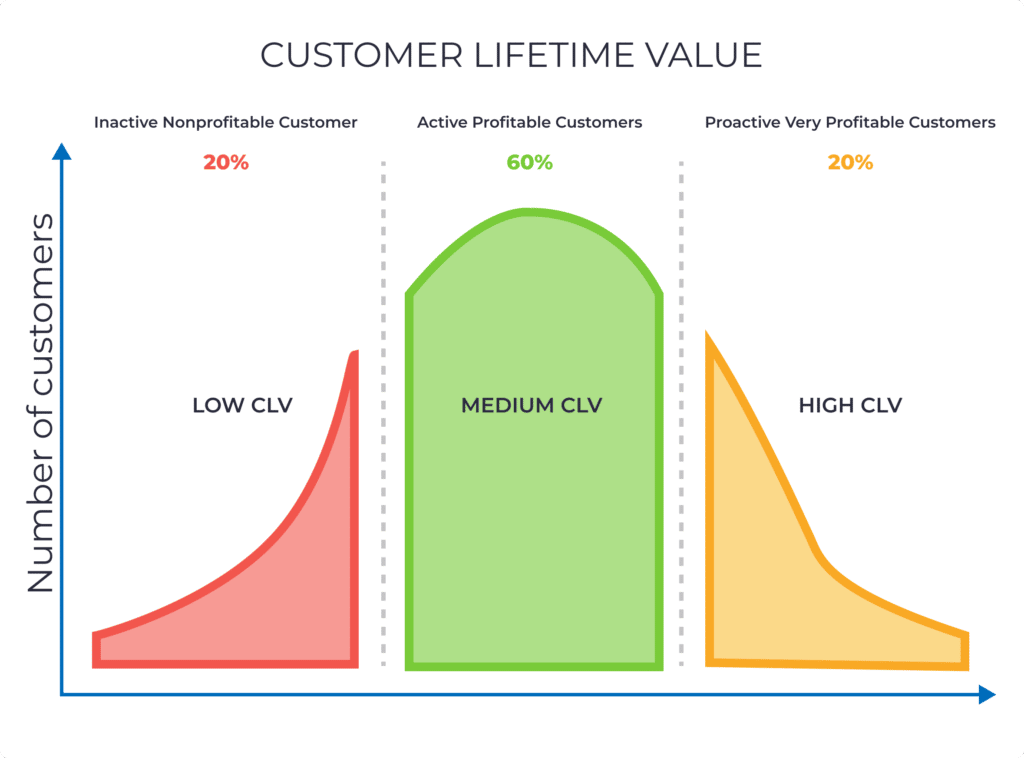
CLV is useful to track when teams want to understand how customer experience and customer success initiatives relate to business value. It can help inform:
- The efficiency of CX and CS initiatives and what money can be allocated to improve them
- How customer acquisition cost compares with the revenue a customer may bring in
- Whether investment in CS and CX appears proportionate to longer-term returns
- Whether future resources could be allocated to initiatives that may increase CLV
Why Is Customer Lifetime Value Important?
Customer lifetime value helps teams compare the long-term value of customer relationships and make more informed choices about acquisition, retention, and investment. Revenue alone does not establish customer profitability because customers can differ in both the revenue they generate and the costs associated with serving them. Harvard Business Review’s analysis of customer value supports this distinction: a customer who generates more revenue is not automatically more profitable.
“By optimizing your customer lifetime value, you may realize that you’re spending huge sums on acquiring customers because you haven’t made enough of an investment in your loyalty programs. For example, if your customer acquisition cost (CAC) for a net-new customer is 30% of your first sale, then it makes sense to provide discounts and promotions to your past customers at 10-20%.
You’ll need to think differently about how you measure and attribute various programs. Vanity advertising metrics and surface-level attribution models, such as last-click, need to be replaced with more comprehensive forms of measurement. It’s vital to make an investment in truly understanding your CLV and separate out the cost per acquisition (CPA) for new and repeat customers. You’ll probably find that you’re burning a lot of dollars that you could be sharing with your customers via loyalty programs, and driving faster, more sustainable growth.”
For example, a high-spending account may also require substantial service resources, while a smaller account may be inexpensive to support and remain a customer for longer. A revenue-only CLV estimate can help compare sales contribution, but it should not be described as profit unless the calculation includes relevant margins and costs. CLV therefore works best alongside other measures rather than as a replacement for them.
Other indicators such as the number of new customers, cost per acquisition, retention rate, and conversion rate are crucial to company analytics. CLV adds a longer-term view of the expected value of a customer or customer group. For marketing, it can help compare customer acquisition spending with expected customer value; for customer success, it can help assess retention priorities and the potential return of support initiatives. The result remains an estimate, not a complete account of every customer relationship.
Is Customer Lifetime Value Actually Useful?
Generally speaking, customer lifetime value is a useful metric to track. How useful it is tends to vary based on:
- The methodology you pick for your CLTV formula (see below)
- The age of your business, product, and services
- The accumulated experience of your customer-facing team members
- How well your customers understand your product and its value
Let me explain with an example:
You’re a startup and you pick the predictive formula for CLV and try to integrate it into your reports. Not only will the factors in your formula be incomplete, irrelevant, or completely missing, but you’ll spend a lot of time calculating it. That effort may be disproportionate to the size and experience of your team.
In the end, it may not tell you much because startups change quickly. Your predictions can become irrelevant after a major product update or a change in customer mix. In that situation, a simpler historical calculation may be more useful until your business has enough consistent information to support a more detailed estimate. The point is to choose a method that fits the decision and the quality of your data.
The question then becomes:
How to Use Customer Lifetime Value (CLTV)?
CLV can waste time and money if used improperly. Once you have a CLV metric in place, use it to inform day-to-day business activities, not as a standalone answer. For example, compare expected customer value with acquisition cost before reviewing acquisition spend, and examine the segments that contribute most to the result before changing retention priorities. The calculation can guide a decision, but it cannot make one without context.
- Tracking business profitability in one metric
- Improving client segmentation
- Evaluating customer loyalty
- Measuring marketing budgets against customer return on investment
- Tracking product fit by customer segment
- Benchmarking efforts intended to improve profitability
- Discovering the most profitable acquisition channels
- Identifying the most profitable customer or customer segment
- Prioritizing customer complaints

What’s the Difference Between CLV and LTV?
If you’ve heard of CLV, you’ve likely heard of LTV. Many use them interchangeably, while others track different things through them.
Both CLV and LTV often mean the same thing: the average value of a customer over the entire relationship with a business. However, here’s where differences can appear:
- LTV is often used as an aggregate metric: the lifetime value of the average customer or the net value of relationships between customers and a brand.
- CLV, on the other hand, may represent the lifetime value of an individual customer.
The difference is often more about methodology than terminology. The base formula for a single customer’s lifetime value can be helpful in certain situations and can inform internal reports and processes. It can also be a useful substitute when a business does not have a simple, predictable sales cycle.
That being said, the aggregate metric is more commonly included in business reports. Investors may use the LTV:CAC ratio to assess the relationship between customer value and acquisition costs. The ratio’s meaning depends on how each input is defined, so compare like-for-like calculations when reviewing performance.
Speaking of calculations:
How to Calculate Customer Lifetime Value
There are three ways of calculating customer lifetime value, each with a different approach and suited for different scenarios. For example, the Basic method of calculating CLV is best for on-the-fly calculations and quick reports. Your choice of formula determines which inputs matter and what the result represents, so label the output as revenue, gross-margin contribution, or another measure accordingly.
Let’s examine them in detail:
CLV Methodologies and Formulas
1. The Basic CLV Formula
The simplest method to calculate CLV is the historical formula, based on the average returns per user:

Where:

The calculation uses average revenue per user (ARPU), adjusted for the average length of customer relationships. Assuming the average length of your customer relationships is 12 months, the CLV formula becomes:

The basic, historical CLV formula is great for:
- Quick, on-the-fly calculations
- Small teams that need to monitor CLV
2. The Cohort CLV Formula
An evolution of the Basic CLTV formula that uses ARPU, the cohort version calculates different CLVs based on segmentation. You can use time or other metrics to separate users into segments. The comparison can then reveal how different customer groups contribute value, as long as each cohort is measured consistently.
It’s best to work on an example:
- We have three cohorts of users: basic, advanced, and premium, each corresponding to a specific account type in our SaaS product.
- The basic subscription is $99 per month, the advanced one is $190 per month, and the premium version is $380 per month.
- Customers can add features monthly, priced at $5, $7, and $10.
- The average customer relationship lasts 12 months for basic users, 7 months for advanced users, and 4 months for premium users.
Using the ARPU-based formula above, the results look like this:

Reviewing the table above, we can see the cohort methodology of calculating customer lifetime value has some advantages:
- The analysis shows the most valuable cohort, or in this case subscription type. If this were a real CLV calculation, we’d be able to tell that:
– a Premium account is more important for this business than a Basic or Advanced account. Even if a basic account keeps adding extra billable features every few months and a Premium account cancels after 4 months, the company still earns more revenue from the Premium one.
– By factoring in the average number of users, Basic accounts immediately shoot up, earning far more for the business compared to the other types of accounts.
NOTE: the specifics of your CLV analysis will naturally depend on your business and billing models. - This will change based on your business and pricing models, but the insights you can glean will be equally valuable.
- The analysis shows ARPU per month while highlighting the impact of extra features.
- While complicated to look at, the technical know-how needed to create a Cohort CLV report is not that advanced.
There’s also a significant disadvantage to performing a cohort CLV analysis:
- Since it uses existing metrics, the analysis can only be completed on a historical basis, therefore predictions based on it are going to be slightly inaccurate, but not as inaccurate as the basic CLV formula above.
In this example, multiplying the subscription revenue by the relationship length gives a revenue estimate, not profit. The premium plan’s apparent lead may change if gross margin, servicing costs, or other relevant expenses differ by cohort. Treat the results as a comparison using the stated inputs, then include additional costs when the business decision requires a profitability view.
The cohort analysis and historical CLV formula is great for:
- Complex predictions using basic calculations
- Medium teams that can afford the time to create a complex table like the one above
3. The Predictive CLV Formula
Our personal favorite, the predictive value CLV formula is very complex, but also useful from a business perspective. It combines several metrics to form a predictive model for customer lifetime value.
So if you’re wondering whether you can predict CLV – the answer is yes, mostly. This formula can support a more informed prediction, but it is still a prediction, not a view into the future:

The only complex factor to calculate here is the average gross margin, which you can get by using this formula:


The predictive CLV formula is great for:
- The most accurate prediction based on multiple sets of data
- Getting a full picture of your CLV, with all relevant metrics factored in
- Complex reports, overviews, and strategies
- Venture capitalists and investors
How to Calculate CLV in Excel / Sheets
We’ve compiled a publicly available spreadsheet containing the basic historical CLV formula, ready to copy and paste into your Excel or Sheets document. Use the CLV spreadsheet as a starting point, then make sure the inputs match the period and customer group you are assessing.
Preview of the customer lifetime value spreadsheet
- For the Cohort Analysis, you need to create your own version of the table we added in the Cohort analysis section.
- For the Predictive CLV equation, you will first need to manually calculate your average gross margin. Then, you can calculate your CLV as all other factors in the predictive formula are values you should already have.
Troubleshooting: Can Customer Lifetime Value Be Negative?
You may have run any of the CLV formulas we’ve listed above and the result turned out to be negative. What happened? First of all, don’t panic. Your CLV formula can return a negative result. It’s usually one of three possibilities:
- You’ve spent too much on a customer compared to the value they bring to your business.
- There is something wrong with your formula. Check to see if any of the factors in the CLV equation are negative and work backward from there to see what’s wrong. CLV cannot be negative if none of the factors that make up the CLV formula are negative.
- Your spreadsheet cell is in the wrong format. Incorrectly formatted cells can sometimes return unexpected negative results, so check the values and formats before drawing conclusions.
How to Increase Customer Lifetime Value
To improve your CLV, you can pick any of the tactics we present in our Customer Success Strategy guide. For right now, we’ll summarize the top ones that directly affect and increase CLV. Choose actions that support customer outcomes as well as longer-term business value.
1. Streamline Your Onboarding Process
It all starts with onboarding. The best chance you have of a high CLV for any account is to make sure customers understand your product, the value it brings to them and their business, and exactly how it helps them achieve their goals.
Holding onboarding calls, conducting product tours, and helping customers with setup are valuable for users and can improve the return from that account over time. You also need to make sure there’s a proper handover from Sales, so that you, as a CSM, have the necessary information to move forward efficiently. A smooth start gives the customer a clearer path to value and gives your team a stronger basis for understanding their goals.
2. Prioritize Upsells, Cross-Sells
The most straightforward way to increase customer lifetime value is to increase the value of the account by upgrading it or adding features the customer needs. Great CSMs know when, where, and how to present upgrade offers so they are advantageous to the customer.
Don’t force the issue, however. Throughout the customer lifecycle, there will be opportunities when extra features could be beneficial. Look for those moments and pursue them when the offer matches the customer’s needs. A sale that does not support customer value may raise short-term revenue without improving the relationship.
3. Start an Incentivized Referral Program
To increase CLV with referrals, you’ll need to adjust the formulas to factor referral value in, but referral revenue can add to the value associated with a customer. Incentivized referral programs typically consist of three phases:
- You come up with an incentive to encourage customers to refer their friends and business connections.
- Your customers start bringing in leads.
- Those referrals turn into clients and the original customers receive the promised rewards.
4. Evolve It into a Loyalty Program
For your next customer success magic trick, you can turn your referral program into a loyalty program by adding loyalty rewards, standardizing referral bonuses, and treating your best customers appropriately.
Turning retained accounts into loyal customers has a lot of benefits:
- They’ll stay with you longer, increasing CLV.
- They’ll be more inclined to make more purchases, further increasing CLV.
- They’ll notice the special treatment and actively promote your business to their friends.
- They’ll come to you for any concern, leading to more upsell and cross-sell opportunities and potentially increasing CLV further.
5. Rave About Every Update
When you launch an update, customers may talk about its features, stability improvements, or bug fixes. As a CSM interested in increasing customer lifetime value, you need to make sure customers understand what has changed and how it could help them.
That means:
- Being markedly excited about new features.
- Appreciating stability improvements.
- Calling attention to bug fixes.
Overall, imagine you’re presenting your own update. You should be able to explain its value clearly and authentically. That helps customers understand the change, decide whether to use it, and see how it relates to their goals.
6. Create a Community
Humans are predominantly social and need a sense of belonging, with community holding a special meaning for us. Bringing your most loyal customers into a group, whether on Discord, Slack, or another online platform, can help them feel that they belong and are part of something bigger. This, in turn, may increase their average customer lifecycle and CLV.
7. Create an Offboarding Script with Counteroffers
If your churn rate is worrisome, consider creating an offboarding script that includes counteroffers. That way, you can attempt to save accounts that are considering leaving.
Set up interviews and prepare a script so the team can understand why customers are leaving and respond consistently. A counteroffer may help in some cases, but it should address a real customer concern rather than simply delaying cancellation.
Note: be cautious when selecting your counteroffers. If you pick the wrong ones or offer too many, you may be actively decreasing your CLV, and that’s the opposite of what you want.
Note: How to Maximize Customer Lifetime Value?
The best way to maximize CLV is to adopt the methods for increasing it that you can reasonably fit into your workflow. Optimizing onboarding, offboarding, upsells, referrals, and other customer interactions at the same time can help increase CLV, but the work should remain manageable and tied to customer needs.
Creating a voice of the customer program is also a great way to increase the lifetime value of a single customer. By prioritizing feedback from one of your best-fit clients, you may identify an improvement that increases CLV for more customers at the same time.
Keeping Customers for Life
Now that you’ve understood how to calculate CLV and how it can inform business decisions, you’re better equipped to consider the long-term financial contribution of your customer relationships.
One of the main topics of interest for CSMs has always been the ROI of customer success:
- How to increase ROI
- How to manage the attribution side
- How to prove the value of CS efforts
The answer? CLV is one powerful metric that can help you tackle these questions while also giving insight into long-term value and why customer success work matters. Use it with the context of your inputs and alongside other business measures, and it can help teams assess where to focus their efforts.
Frequently Asked Questions
What is a good LTV:CAC ratio for SaaS?
A good LTV:CAC ratio for a SaaS business is 3:1 or higher, meaning the lifetime value of a customer is at least three times the cost of acquiring that customer. The benchmark comes from investor David Skok’s SaaS Metrics 2.0 guidelines, which note that the best SaaS businesses reach higher ratios. A lower ratio suggests acquisition costs are too high or customers leave too early. Both sides of the ratio should use the same customer lifetime value (CLV) definition.
How do you calculate average customer lifespan for CLV?
Average customer lifespan is estimated by dividing 1 by the churn rate. A SaaS company with a 2% monthly churn rate has an average customer lifespan of 50 months (1 ÷ 0.02), and one with a 20% annual churn rate has 5 years. The estimate assumes a steady churn rate. It supplies the relationship length used in the basic customer lifetime value (CLV) formula, so the churn rate and the revenue figure should cover the same period.
How does customer success software help increase customer lifetime value?
Customer success software helps increase customer lifetime value (CLV) by showing which accounts are at risk and which are ready to grow before renewal. A platform such as Custify combines product usage, lifecycle, and account data into customer health scores, flags churn risk, surfaces renewal and upsell opportunities, and runs playbooks automatically. Customer success managers can then act while there is still time to extend the relationship.


